How Do You Know When It Is Time to Lift Heavier?
Sep 15, 2026
by Coach Steph - Stephanie Ward
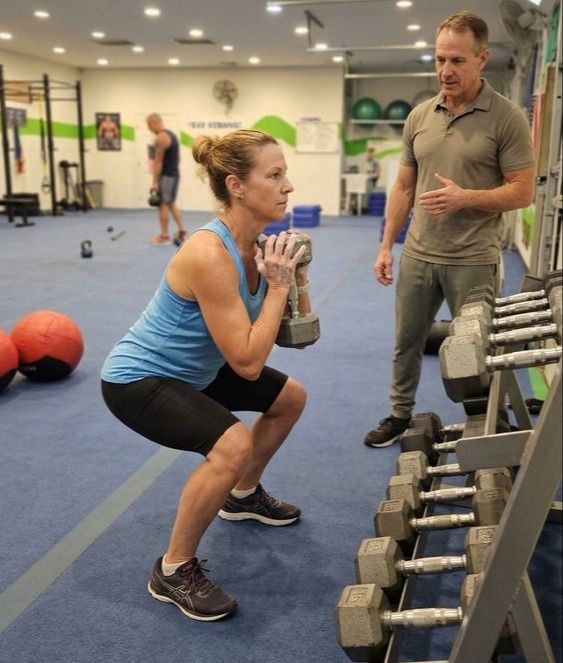
Getting stronger does not mean adding more weight every time you walk into the gym.
You are usually ready to increase resistance when you can complete your planned repetitions with consistent technique, good control, and enough capacity that the current weight is no longer providing the intended challenge.
That sounds simple, but knowing when to progress is one of the most important skills in strength training.
Increase too quickly and your technique may suffer. Never increase the challenge, and your progress may eventually slow.
The goal is not to lift the heaviest weight possible. It is to gradually ask your body to do more while maintaining quality movement.
This principle is called progressive overload, and understanding it can make your workouts much more purposeful. 💪
What Progressive Overload Actually Means
Progressive overload simply means gradually increasing the demands of your training as your abilities improve.
Importantly, that does not always mean adding weight.
The American College of Sports Medicine released an updated resistance training position stand in 2026 emphasizing that programs should be matched to individual goals and that consistency matters more than unnecessary complexity.
ACSM also recommends training all major muscle groups at least twice per week as a useful foundation for healthy adults.
Progress can involve:
- Adding resistance
- Completing more quality repetitions
- Performing additional sets when appropriate
- Improving your range of motion
- Improving control and technique
- Advancing to a more challenging exercise variation
The important word is gradually.
Your workout should become more challenging as your body adapts, but progression should not come at the expense of good movement.
Four Signs You May Be Ready to Increase the Weight
1. Your Technique Remains Consistent
Before worrying about the number printed on a dumbbell, look at the quality of your repetitions.
- Can you perform the exercise through the intended range of motion?
- Can you maintain your posture?
- Are your final repetitions still controlled?
If increasing the weight causes your technique to change substantially, the heavier resistance may not be appropriate yet.
Better movement is progress too.
Train Strong Fit’s personal training in Ashland, VA emphasizes customized workouts, proper technique, progress tracking, and adjusting the training plan as needed.
2. You Can Consistently Complete Your Target Repetitions
Imagine your coach gives you a target of 8 to 10 repetitions.
At first, 8 repetitions may feel appropriately challenging.
Several sessions later, you may be able to complete 10 with good control and feel capable of doing more.
That can be a sign that the current resistance is becoming easier for you.
Instead of immediately making a large jump, a coach might make a modest adjustment and see how you respond.
This is one reason recording workouts is useful. Memory is not always a reliable training log.
3. The Same Workout Feels Noticeably Easier
Think back to your first few weeks of training.
An exercise that once required intense concentration may eventually feel familiar and controlled.
That is not a problem.
It is evidence that you are adapting.
The next challenge should still be appropriate for your current ability. More difficult is useful only when it remains productive.
4. You Are Recovering Well Between Sessions
Progression is not just about what happens during one workout.
Ask yourself how you feel between sessions.
Are you generally recovering before your next workout?
Has your performance remained stable?
Can you complete your planned training without persistent excessive fatigue?
Recovery needs vary between people. Sleep, stress, nutrition, training history, and other activity can all affect readiness.
A heavier dumbbell is not automatically the right next step just because you successfully lifted the current one once.
Use This Simple Progression Checklist 📋
Before increasing resistance, ask yourself:
Did I complete the prescribed repetitions?
Was my technique consistent from the first repetition to the last?
Did I maintain the intended range of motion?
Did the exercise feel controlled rather than chaotic?
Have I performed well with this resistance more than once?
Am I recovering reasonably well between workouts?
If several answers are no, staying at the current resistance may be more productive.
If the answers are consistently yes, discuss the next progression with your coach.
Progress Is More Than Adding Weight
This is where many people misunderstand strength training.
Suppose you performed 8 controlled goblet squats last month and can now perform 10 with the same resistance and better technique.
You progressed.
Suppose your push-ups once required an elevated surface and you can now perform them from a lower elevation with excellent control.
You progressed.
Suppose you can perform a movement through a fuller comfortable range than when you started.
That can also represent progress.
Adding resistance is easy to measure, which is why people focus on it. But it is only one tool.
Train Strong Fit’s group training classes combine full-body strength and weight training with cardiovascular conditioning, core work, agility, and mobility. The business also offers a customizable Low Impact Training class for people who want to strengthen their whole body without running and jumping.
Those options illustrate an important principle: progression should match the person rather than forcing every person through the same path.
A Practical Example of Progression
Consider a hypothetical beginner learning a dumbbell squat.
Their progression might look something like this:
| Stage | What Changes | Main Focus |
|---|---|---|
| First | Comfortable resistance | Learn the movement |
| Next | Same resistance, better repetitions | Control and consistency |
| Next | More repetitions within the planned range | Build capacity |
| Next | Small resistance increase | Create a new challenge |
| Next | Build quality repetitions again | Adapt to the new resistance |
Notice what is missing.
There is no requirement to add weight every Monday.
Progress happens when the person is ready for the next challenge.
What If You Cannot Increase the Weight Yet?
Do not assume you have hit a plateau.
Sometimes the jump between available dumbbells is simply too large. Sometimes you are still developing technique. Sometimes work, sleep, or other demands affect your performance that week.
You can still make a workout more productive without immediately lifting heavier.
Depending on your program, your coach might have you improve your repetitions, movement control, range of motion, or another training variable.
ACSM’s current guidance reinforces a useful message for recreational exercisers: complicated methods are not automatically better.
Consistency and appropriate progression matter more. 🧠
Common Mistakes When Trying to Get Stronger
Chasing Weight Instead of Technique
The number only matters if you can control it.
Using momentum, shortening your range, or substantially changing your technique just to move a heavier weight is not necessarily meaningful progress.
Comparing Your Weight to Someone Else's
Two people can perform the same exercise with very different loads, and both have productive workouts.
Training history, anatomy, goals, age, recovery, and many other factors affect performance.
Your most useful comparison is your own previous training.
Changing Everything at Once
Adding more resistance, more repetitions, more sets, and more training days simultaneously makes it difficult to understand how your body is responding.
Progress does not need to be dramatic.
Assuming Every Workout Must Beat the Last One
Human performance is not perfectly linear.
Some days you will feel stronger than others.
One difficult workout does not mean your program has stopped working.
Look for progress across weeks and months rather than demanding a personal record every session.
How Often Should Adults Strength Train?
For general health, the CDC recommends that adults perform muscle strengthening activities involving the major muscle groups on at least two days each week. The CDC also recommends at least 150 minutes of moderate-intensity aerobic activity per week, or 75 minutes of vigorous activity, or an equivalent combination.
These are public health recommendations, not a personalized training prescription.
Your appropriate frequency depends on your goals, experience, health, schedule, and recovery.
If you are new to exercise, you do not need to immediately train every day. A sustainable routine that you can gradually build is more useful than an aggressive schedule you cannot maintain.
People with chronic health conditions or disabilities should discuss appropriate types and amounts of activity with a health care professional or qualified physical activity specialist when needed.
FAQ
Should I increase weight every week?
Not necessarily. Increase the training challenge when your performance indicates you are ready. Your rate of progression will depend on the exercise and your individual circumstances.
Does progressive overload always mean lifting heavier?
No. Progress can also involve more quality repetitions, improved range of motion, better control, additional training volume when appropriate, or a more challenging variation.
What if heavier weight causes my form to break down?
Reduce the resistance and prioritize technique. The purpose of progression is to create an appropriate new challenge, not simply move a bigger number.
Can beginners use progressive overload?
Yes. In fact, beginners can benefit from learning the principle early. Initially, however, progress may be better measured through improved technique, consistency, coordination, and gradually increasing capacity rather than constantly adding resistance.
Stronger Does Not Always Mean Heavier
One of the best signs that your training is working is not simply that you can lift more.
It is that movements you once found difficult become more controlled, confident, and manageable.
Then you earn the opportunity to make them challenging again.
That cycle of challenge, adaptation, and thoughtful progression is what makes strength training sustainable.
If you are in Ashland or the Richmond area and would rather have a coach determine when and how your training should progress, Train Strong Fit offers personal training with customized workouts, technique instruction, progress tracking, and ongoing program adjustments.